



The dashboard has many possibilities. To help you find your way around, this page shows you how to use the dashboard, with examples of research questions. We would appreciate any questions or suggestions you may have about this dashboard.
Example 1: a line graph of sucralose
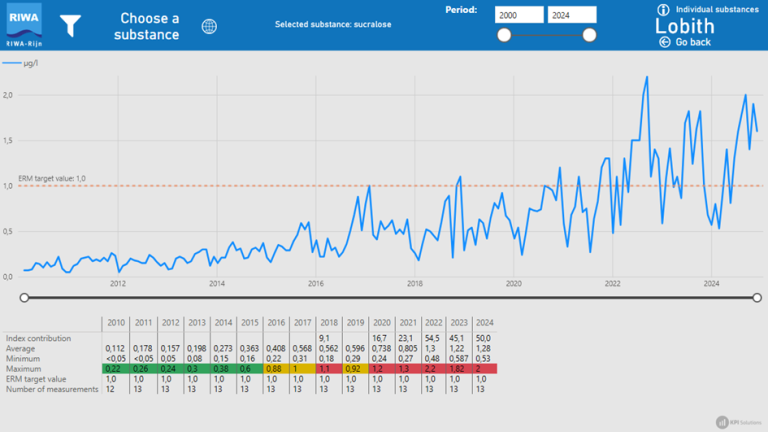
Would you like to see, for example, how the concentration of sucralose evolves? You can view this via the ‘line graphs’ tab.
The red dotted line in the graph indicates the ERM target value. The table below the graph shows the key figures by year.
Useful tips:
Example 2: a graph of several sweeteners
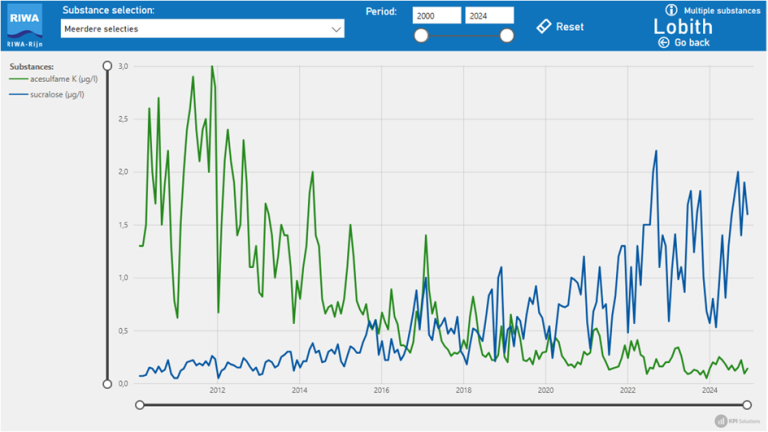
You can compare several substances at once or make all substances in a substance group visible via the ‘multiple substances’ option in the ‘line graphs’ tab.
The graph shows that acesulfame-K concentrations have decreased over the years, but sucralose concentrations are increasing.
Useful tip:
Example 3: Compare sucralose concentrations between sites
Do you want to see how sucralose concentrations evolve across sites? Then follow these steps in the ‘line graphs’ tab:
The graph shows that sucralose concentrations are increasing at both locations, but the increase is faster at Nieuwegein than at Lobith.
Useful tip:
The target values from the European River Memorandum (ERM) describe the water quality required to produce clean drinking water using natural purification techniques. These values are used by European drinking water companies that depend on river water, such as those from the rivers Rhine, Meuse and Danube. They therefore form the core of the water quality assessment for RIWA-Rijn.
How does it work?
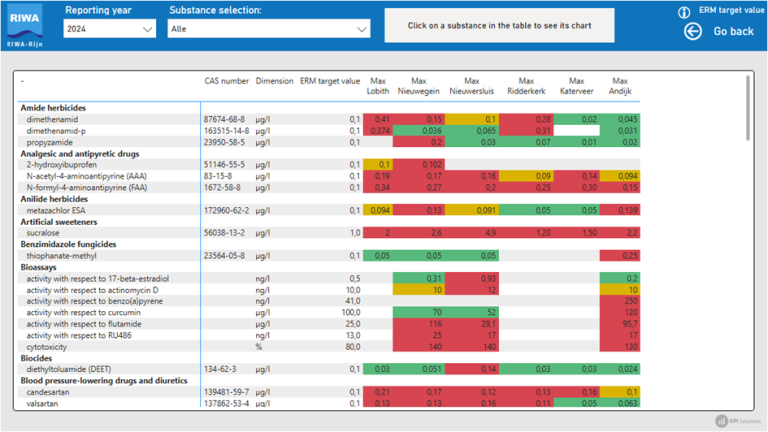
The table shows the substances that exceeded the ERM target value once or more at one or more locations in the selected year. The table shows the highest measured concentration per location. Values above the ERM target value (such as 1 µg/l for sucralose) are coloured red, values close to the ERM target value are coloured yellow.
For example, you can see that sucralose exceeded the ERM target value at all locations in 2023, and the same is true for acesulfame-K in 2014.
With the Removal Requirement Index, we monitor whether the goal of article 7.3 of the Water Framework Directive (WFD) is met. This article states that the level of purification treatment required for drinking water production must be reduced. The index shows whether the removal requirement is decreasing and thus whether this WFD goal is being met. However, so far we see that this is not the case in the Rhine in the Netherlands.
The Removal Requirement Index shows how much a drinking water company has to purify in order to convert river water into drinking water. It shows the difference between the quality of the river water and the requirements for drinking water, defined in the Dutch Drinking Water Decree (DWB).
You can find more information on the methodology in the explanation on the ‘Removal Requirement Index’ tab and in the theme report ‘ Removal requirement and purification treatment effort for Dutch Rhine water from 2000-2018’
The ‘Removal Requirement Index’ tab allows you to see a number of views of the Removal Requirement Index at our reporting locations:
Example 1: the trend of the Removal Requirement Index
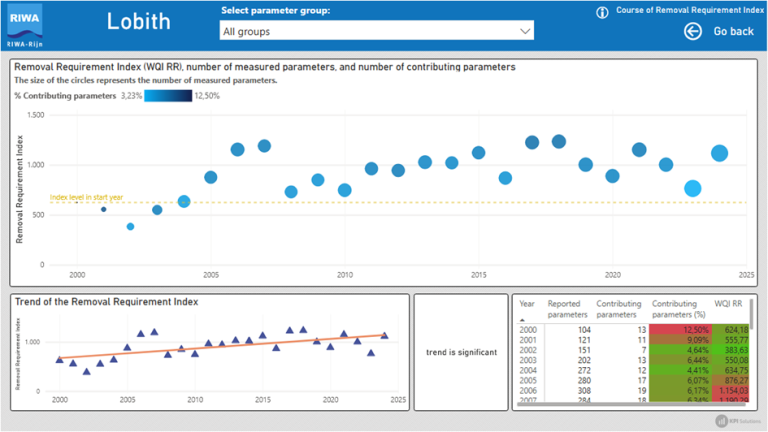
Do you want to see how the index develops at a specific location? Then follow these steps in the ‘Removal Requirement Index’ tab:
Useful tip:
Example 2: graph of relative contribution per substance group
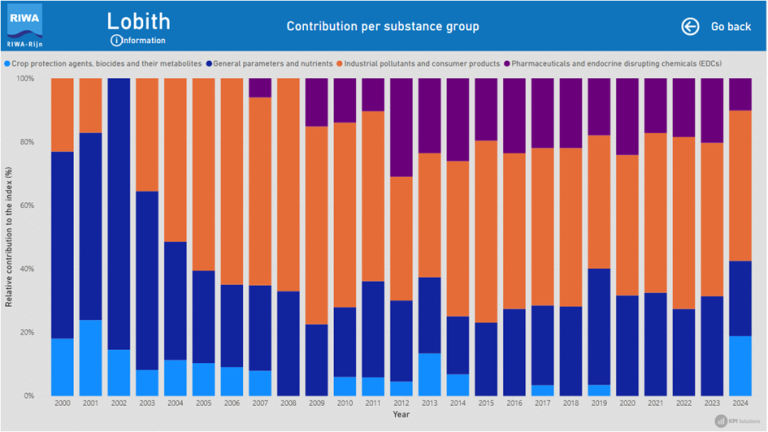
If you are interested in the relative contribution to the index per substance group per year, you can look it up as follows:
Example 3: ribbon graph of individual contributing substances to the index
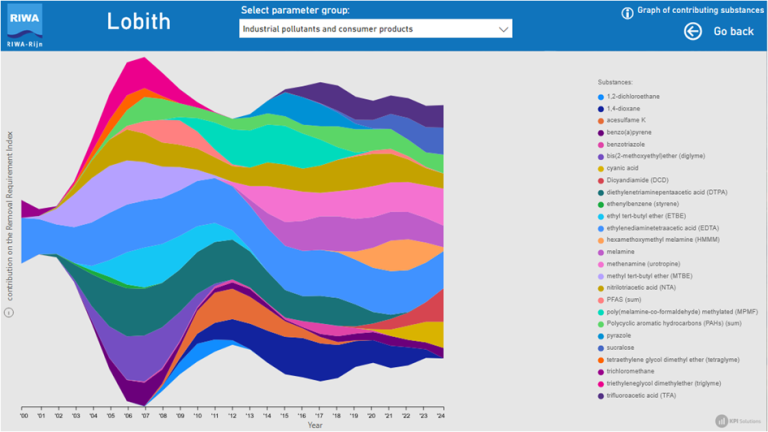
In Example 2, you were able to see which main group made the largest contribution to the index per year. Would you like to examine in more detail what the contribution was of the individual substances in this substance group? You can see this in the ribbon graphs:
For the ‘Industrial pollutants and consumer products’ group in Lobith, you can see that, for example, the substance EDTA has a large contribution to the Removal Requirement Index in most years. ETBE had a removal requirement from 2001 to 2010 and then the concentrations decreased again. In the last few years, you can see TFA, sucralose and HMMM, among others, appearing in the index.
Useful tip:
We hope you enjoy exploring the dashboard and our data.